


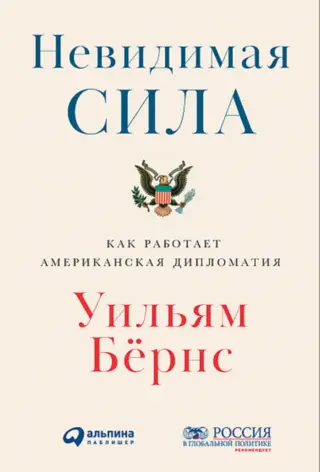
Invisible Force: How American Diplomacy Works – William Burns – Alpina Publisher – 2020 – ISBN 978-5-9614-2828-5
Invisible Force: How American Diplomacy Works
69.99 €
Out of stock

Invisible Force: How American Diplomacy Works
69.99 €
To add a product to the waitlist, please sign in:
Log in
William Burns, described by The Atlantic as the "secret diplomatic weapon" of the United States, has served the U.S. State Department under five presidents and ten secretaries of state. During his long career, Burns has been involved in many significant events in recent years: Operation Desert Storm in 1991, the invasion of Yugoslavia in 1999, the NATO enlargement debate, and the Iran nuclear deal. In the book, the author reveals previously unknown historical details and cites recently declassified telegrams and memoranda that provide a rare opportunity to understand how diplomatic work is actually conducted - far from being conducted only through official channels, through ambassadors and summits. Since William Burns has been active on the Russian side since the late 1980s and served as U.S. ambassador to Russia from 2005-2008, his views on Russian policy and the situation in the country can provide much valuable information about why U.S.-Russian relations were built one way or another and why they eventually stalled. The issue of NATO expansion and the admission of Russia's former Warsaw Pact allies into the organization was not so simple. Yeltsin and the Russian elite believed, and largely rightly so, that the assurances given by Jim Baker during the 1990 German unification negotiations, when he said that NATO would not be expanded "one inch eastward," would remain in force after the collapse of the Soviet Union. However, Baker's promise was neither precisely articulated nor officially put on paper, so the Clinton administration assumed, and not without reason, that the Secretary of State's promise applied to the USSR, not Russia. Clinton was slow to raise the issue of NATO expansion early in his presidency, but his first national security adviser, Tony Lake, was always in favor of it. Lake argued that the United States and its European allies had a rare historic opportunity to help former communist countries like Poland, Hungary and the Czech Republic get firmly on the path to building democracy and market economies. In response to Obama's question at the beginning of the meeting, Putin's 50-minute monologue, full of insults, barbs and snide comments, was nothing short of astonishing. I wondered if I had given our president the right advice and wondered if I had a future in his administration. The meeting was supposed to last only an hour, and Putin had already spoken for most of it. He hosted us in luxurious surroundings, under a canopy in an elaborate courtyard. Waiters dressed in 18th century costumes served countless dishes. I drank only coffee and listened to the familiar mournful list of grievances: George W. Bush Jr., whom Putin liked so much, seeing the Russian president's intentions to build a strong relationship after the events of September 11, 2001, had not gone along with him, and the U.S. administration had screwed up in Iraq and orchestrated color revolutions in Ukraine and Georgia. He was less concerned about the Iranian threat than Medvedev, but he spoke with bitter resentment about missile defense and the imagined unwillingness of the George W. Bush administration to listen to his views. Putin was less than courteous, sometimes rude, and generally showed a personal disdain for working with the Americans. After the Gulf War, many of us naively assumed that Saddam Hussein's regime would collapse on its own under the weight of internal contradictions. As skeptical as we were of the claims by most in the intelligence community during the run-up to the 2003 war that Saddam had weapons of mass destruction, we never once considered that the Iraqi dictator might be trying to create the illusion that he had them in order to scare off foreign and domestic enemies. A lack of imagination prevented an honest discussion of the need for war itself, as well as a proper assessment of the risks of an alternative political solution. Needless to say, in a broader sense, our stubborn unwillingness to soberly assess the inevitable negative consequences of war has led to even more tragic results. Baker, who spent hours in Sana'a grooming Yemen's president, warned Ali Abdullah Saleh that his refusal to vote in favor of the resolution would "cost Yemen very, very dearly." The secretary of state wasn't kidding. When Saleh refused to support the resolution, the State Department instantly secured a 90 percent cut in aid to Yemen.
See also:
- All books by the publisher
- All books by the author