


Flowers of Saint Francis of Assisi – NWCEO – 2022 – ISBN 978-5-9603-0771-0
Flowers of Saint Francis of Assisi
14.99 €
Out of stock

Flowers of Saint Francis of Assisi
14.99 €
To add a product to the waitlist, please sign in:
Log in
In the Middle Ages, florigelles (from Latin flora) were collections of extracts from poetic or prose works. Nowadays such collections are called anthologies. One of the florigelia was dedicated to the life and deeds of the famous Italian saint Francis of Assisi. The future ascetic was born in the Italian Assisi, in the family of a silk merchant, who, often being on business in France, named his son Francis. In his youth he led a dissolute life, but after a mystical vision he became a champion of "beggarly living" and founded after some time the Christian order of Franciscans. The first hagiography of Francis, based on folk legends, was written in Latin in the XIV century, that is, at least a century after the death of the saint. Most experts consider the author of this hagiography to be Ugolino Brunforte. At the end of the fourteenth century, a free anonymous reworking of Brunforte's work into the Tuscan dialect of Italian appeared; it consisted of 53 short chapters. In Russian culture, this florigellio is known as "The Flowers of St. Francis of Assisi." Its text is considered one of the most remarkable literary works of the Middle Ages. The Florigelles were translated into Russian by Alexander Pechkovsky, who omitted several fragments of the text. In this edition they are fully restored.
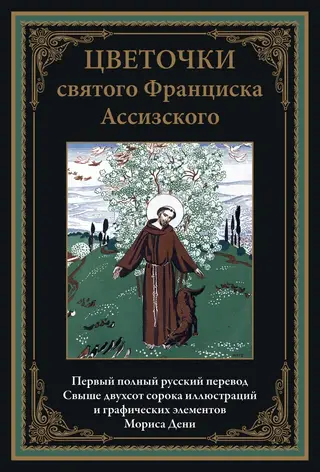
In this edition, "Tsvetochki" is decorated with ornaments, letters and colored drawings by the French symbolist artist Maurice Denis. He was not only a talented illustrator but also an art theorist, although his childhood was spent in a very ordinary family; his father was a railroad clerk, his mother a modiste. However, the young man woke up early craving for self-education. He began to study at the Academy Julian; in the second half of XIX century, this private institution competed with the famous Paris School of Fine Arts. After classes in drawing classes young Maurice ran to lectures on philosophy and read the works of Schopenhauer. Denis was fascinated by the Symbolists, it is no coincidence that he believed that the main role of the artist is to "visualize dreams", in the ability to inspire with the help of pictorial means of those or other ideas, sensations and feelings. Denis was one of the founders of the famous Nabi group; he became its theorist. The artist worked a lot and fruitfully - painted, made paintings of interiors, gave lectures, wrote articles devoted to art. Illustrations for "Flowers" demonstrate his favorite painting techniques - deliberate simplicity of forms, dim colors, smooth lines. When Denis turned 62 in 1932, he was awarded the title of academician of painting.
In this edition, "Tsvetochki" is decorated with ornaments, letters and colored drawings by the French symbolist artist Maurice Denis. He was not only a talented illustrator but also an art theorist, although his childhood was spent in a very ordinary family; his father was a railroad clerk, his mother a modiste. However, the young man woke up early craving for self-education. He began to study at the Academy Julian; in the second half of XIX century, this private institution competed with the famous Paris School of Fine Arts. After classes in drawing classes young Maurice ran to lectures on philosophy and read the works of Schopenhauer. Denis was fascinated by the Symbolists, it is no coincidence that he believed that the main role of the artist is to "visualize dreams", in the ability to inspire with the help of pictorial means of those or other ideas, sensations and feelings. Denis was one of the founders of the famous Nabi group; he became its theorist. The artist worked a lot and fruitfully - painted, made paintings of interiors, gave lectures, wrote articles devoted to art. Illustrations for "Flowers" demonstrate his favorite painting techniques - deliberate simplicity of forms, dim colors, smooth lines. When Denis turned 62 in 1932, he was awarded the title of academician of painting.
See also:
- All books by the publisher
- All books in the series Library of World Literature